Cardiac Tamponade

A Critical Medical Emergency – Baltimore Cardiac Tamponade Lawyer Mark Kopec

Cardiac tamponade is a life-threatening medical condition that occurs when fluid builds up in the space between the heart muscle and the outer covering of the heart. This accumulation of fluid creates extreme pressure, preventing the heart’s ventricles from expanding fully. When the heart cannot expand, it cannot fill with enough blood, leading to a drastic drop in blood pressure and, eventually, systemic organ failure. Baltimore cardiac tamponade lawyer Mark Kopec provides you with this article to explain the various aspects of this condition and potential medical malpractice claims.

In the context of medical care, cardiac tamponade is often a “can’t miss” diagnosis. Because it can progress rapidly from mild discomfort to cardiac arrest, healthcare providers must act with extreme urgency. When they fail to do so—or when their actions cause the condition—it often leads to medical malpractice litigation.


Anatomy of the Heart and the Pericardium

To understand tamponade, one must understand the pericardium. The heart is in a double-walled sac, which is the pericardial sac.
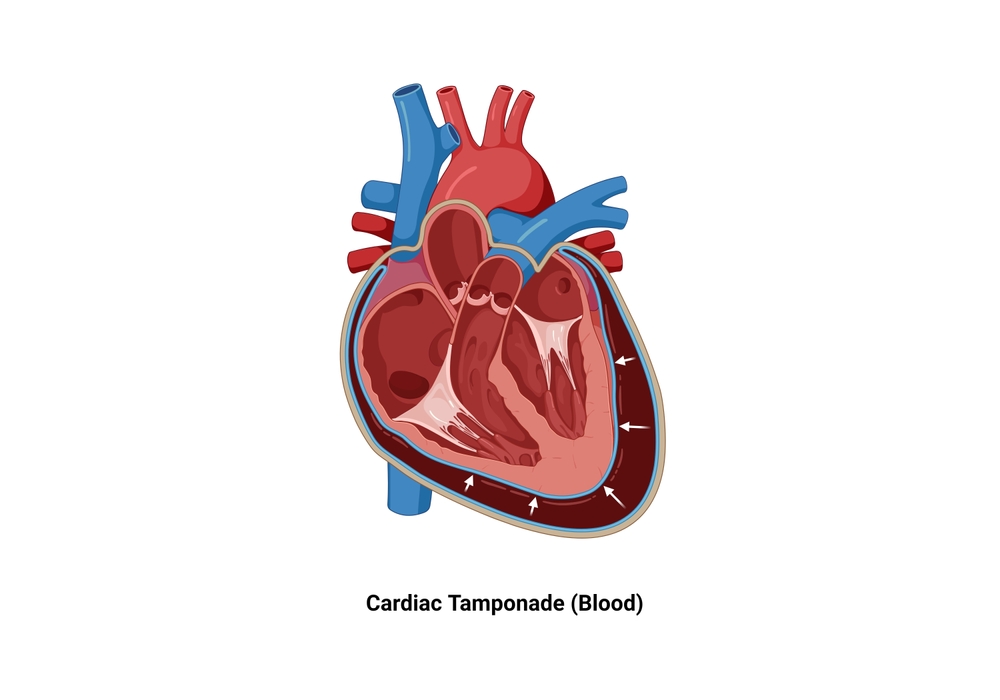
  • Visceral Pericardium: The inner layer that touches the heart.
  • Parietal Pericardium: The tougher outer layer.
  • Pericardial Cavity: The small space between these layers, which normally contains a tiny amount (about 15 to 50 mL) of lubricating fluid to reduce friction as the heart beats.
Baltimore Cardiac Tamponade Lawyer
Baltimore Cardiac Tamponade Lawyer Mark Kopec

In cardiac tamponade, this cavity fills with excess fluid (blood, pus, or effusion). Because the outer parietal pericardium is relatively stiff and inelastic, it cannot stretch quickly. As fluid volume increases, the pressure is directed inward, then compressing the heart chambers.


Causes and Risk Factors

Cardiac tamponade can result from a variety of underlying issues, generally ranging from chronic illness to acute trauma.

Common Causes:

  • Trauma: Penetrating wounds (knife or gunshot) or blunt force trauma (car accidents).
  • Medical Procedures (Iatrogenic): Complications from cardiac catheterization, pacemaker insertion, or central line placements.
  • Aortic Dissection: A tear in the aorta that bleeds into the pericardial sac.
  • Cancer: Metastatic tumors (often lung or breast) causing malignant effusions.
  • Infections: Viral, bacterial, or fungal pericarditis.
  • Post-Surgical Complications: Bleeding following open-heart surgery.

Risk Factors:

Patients with end-stage renal disease (uremia), those on blood thinners (anticoagulants), and individuals with autoimmune diseases like Lupus are at a higher risk for developing pericardial effusions that can lead to tamponade.


Recognizing the Symptoms: The “Beck’s Triad”

The clinical presentation of cardiac tamponade can be subtle at first but usually escalates quickly. Physicians are trained to look for a classic set of three signs known as Beck’s Triad:

  1. Low Blood Pressure (Hypotension): Caused by decreased stroke volume.
  2. Distended Neck Veins (JVD): Blood “backs up” because it cannot enter the compressed right side of the heart.
  3. Muffled Heart Sounds: The fluid layer acts as an insulator, generally making the heartbeat sound distant through a stethoscope.

Other symptoms include shortness of breath (dyspnea), rapid heart rate (tachycardia), lightheadedness, and pulsus paradoxus—a significant drop in blood pressure during inhalation.


Diagnosis: Who to See and What Tests to Run

If a patient presents with symptoms in an Emergency Room, the primary physician involved will be an Emergency Medicine Physician. However, a Cardiologist is usually consulted immediately for definitive diagnosis and management.

Diagnostic Tests:

  • Echocardiogram (Ultrasound): This is the “gold standard.” It allows doctors to see the fluid and observe the heart “swinging” or the right atrium collapsing under pressure.
  • Chest X-Ray: May show an enlarged, “water-bottle shaped” heart.
  • Electrocardiogram (ECG or EKG): May show low voltage or “electrical alternans,” where the height of the waves varies because the heart is physically shifting in the fluid.

Baltimore cardiac tamponade lawyer Mark Kopec will evaluate your diagnosis and advise you on a potential medical malpractice claim.


Treatment: Emergency Intervention

Treatment is focused on removing the fluid to relieve pressure. This is a surgical emergency.

Physicians Involved:

  • Cardiologists: Perform bedside needle drainage.
  • Cardiothoracic Surgeons: Perform open-heart procedures if the cause is a rupture or surgical complication.

Treatment Methods:

  • Pericardiocentesis: A procedure where a long needle is inserted through the chest wall into the pericardial sac to drain the fluid.
  • Pericardial Window: A surgical procedure where a small piece of the pericardium is removed to allow the fluid to drain into the chest cavity continuously.
  • Thoracotomy: In trauma cases, the chest may be opened to repair the source of bleeding.

Potential Outcomes

If treated immediately, many patients recover fully. However, if there is a delay, the outcomes can be catastrophic:

  • Obstructive Shock: Total circulatory collapse.
  • Myocardial Infarction: Stress on the heart leading to a heart attack.
  • Brain Damage: Resulting from a lack of oxygenated blood flow.
  • Death.

Medical malpractice claims involving cardiac tamponade generally fall into two categories: errors in causation and errors in response.

1. Claims Based on Causing Cardiac Tamponade

These claims arise when a healthcare provider’s negligence directly results in the tamponade.

  • Surgical Errors: A surgeon accidentally nicking the heart wall or a coronary artery during a procedure and failing to notice the bleed.
  • Negligent Procedure Performance: An interventional cardiologist piercing the heart during a routine catheterization or a nurse improperly inserting a central venous line, causing a perforation.
  • Anticoagulation Errors: Improperly managing blood thinners, leading to spontaneous bleeding into the pericardium.

2. Claims Based on Responding to Cardiac Tamponade

These claims focus on the “failure to diagnose” or “failure to treat” in a timely manner.

  • Failure to Monitor: Post-surgical teams failing to notice a patient’s dropping blood pressure and rising heart rate (signs of internal bleeding).
  • Misdiagnosis: Dismissing symptoms of tamponade as anxiety, a simple heart attack, or respiratory distress without ordering an echocardiogram.
  • Delay in Intervention: Even if the diagnosis is made, a delay in calling a surgeon or performing a pericardiocentesis can be grounds for malpractice if the patient suffers permanent injury or death during the wait.

In these cases, the legal “standard of care” is the focal point. An expert witness (usually a board-certified cardiologist) must testify that a competent doctor in the same circumstances would have recognized the signs and acted faster.

Next Step: Call Baltimore Cardiac Tamponade Lawyer Mark Kopec

If you have any concerns or questions about cardiac tamponade, then visit our free consultation page or video. Then contact the Kopec Law Firm at 800-604-0704 to speak directly with Attorney Mark Kopec. He is a top-rated Baltimore medical malpractice lawyer. The Kopec Law Firm is in Baltimore and pursues cases throughout Maryland and Washington, D.C.

What Our Clients Say About Us

At the Kopec Law Firm, we are grateful that satisfied clients express their appreciation!

Mark is a knowledgeable and empathetic lawyer who speaks directly and concisely to evaluate your problem. He doesn't use attorney jargon that confuses people, rather he talks clearly. Although he couldn't help me with my situation, the consultation I had was productive because he answered my questions and gave me some clarity.

Shahnaz in Ellicott City

Dear Mark, I just wanted to express my gratitude for your dedication to my case. As you know, it has been a long and upsetting process for me, which would have been a great deal longer had it not been for the hours you put in helping me with this emotional roller coaster. Thank you again.

Shannon T. in Anne Arundel County

Dear Mark, thank you so much for your help and kindness. You provided the guidance and assistance we needed to obtain some understanding in loss of our child. We will never forget the professional and personal service provided. If anyone is in need of legal representation, I will certainly send them your way. God bless.

Kim C. in Cecil County

I wanted to say thank you for spending time with me regarding my questions about legal issues. Mere words cannot really express my gratitude. You seem to truly care about people.

Client in Baltimore City

Dear Mr. Mark, I’m truly grateful to have had you work on my son’s case. You were up front at all times and were on key every step of the way. I will always recommend your firm. Thank you so much for helping my son. P.S. Every time my son sees you on TV, he says “Mom, that’s my lawyer, Mr. Mark.” 🙂 Thank you again. You did an excellent job on the...

K.N. in Baltimore City

Dear Mark, we want to thank you for all the hard work and time your firm put in our case. You took the time to listen to us and research our case. You were honest and up front regarding the case. You responded to questions and concerns quickly. We would highly recommend your firm and services to anyone who is in need of legal representation. We...

Rebecca T. in Prince George’s County

Super Awesome team and staff! Worked with them for a case they handled for my grandchild about 10yrs ago! Would definitely use them again! I recommend them to everyone I know. Could never thank them enough! Very thorough and knowledgeable! Always kept us in the loop throughout the entire process!!!!

Letha C. in Prince George’s County

Mark explained everything in detail and brought clarity to all of my concerns.

Doris in Edgwater

I am very happy and thankful for your help. You responded very quickly. I am very happy to recommend you.

Linda in Chevy Chase
  1. 1 Free Consultation
  2. 2 Talk to a Lawyer
  3. 3 No Fee Unless You Win
Fill out the contact form or call us at 800-604-0704 to schedule your consultation.

Send Us a Message