Talk to Lawyer
Mark Kopec Now
Mark Kopec Now






When the joy of a new birth is overshadowed by a preventable injury, families often find themselves searching for answers. Among the various tools used in modern obstetrics, few carry as much historical weight—or as much potential for controversy—as the obstetric forceps. Forceps instrument misuse can lead to devastating, lifelong consequences for both mother and child, and can result in a medical malpractice claim.
Understanding the legal and medical landscape of forceps-assisted delivery is crucial for any family navigating the aftermath of a birth injury.
Forceps are a specialized medical instrument to assist in the vaginal delivery of a baby. They resemble a pair of large, curved metal “spoons” or “tongs” that are to fit securely around the baby’s head.
Unlike a vacuum extractor, which uses suction on the crown of the head, forceps provide a mechanical grip. This allows an obstetrician to apply traction (pulling). In some cases, rotation to guide the infant through the birth canal.
The invention of the forceps is one of the most curious chapters in medical history. They were developed in the late 16th century by the Chamberlen family, a line of “man-midwives” in England.
For over 100 years, the family kept the tool a strict professional secret to maintain a monopoly on difficult births. They would arrive at a home with a massive, ornate wooden box and require all family members to leave the room. The medical providers would often blindfold the mother so she could not see the “secret” instrument they were using. It wasn’t until the early 18th century that the design became public, eventually evolving into the surgical-grade instruments used in hospitals today.
Doctors use forceps during the “second stage” of labor—the pushing stage. They are typically employed when a vaginal delivery is nearly complete but has stalled, and a C-section is deemed either too slow or too risky at that late stage.
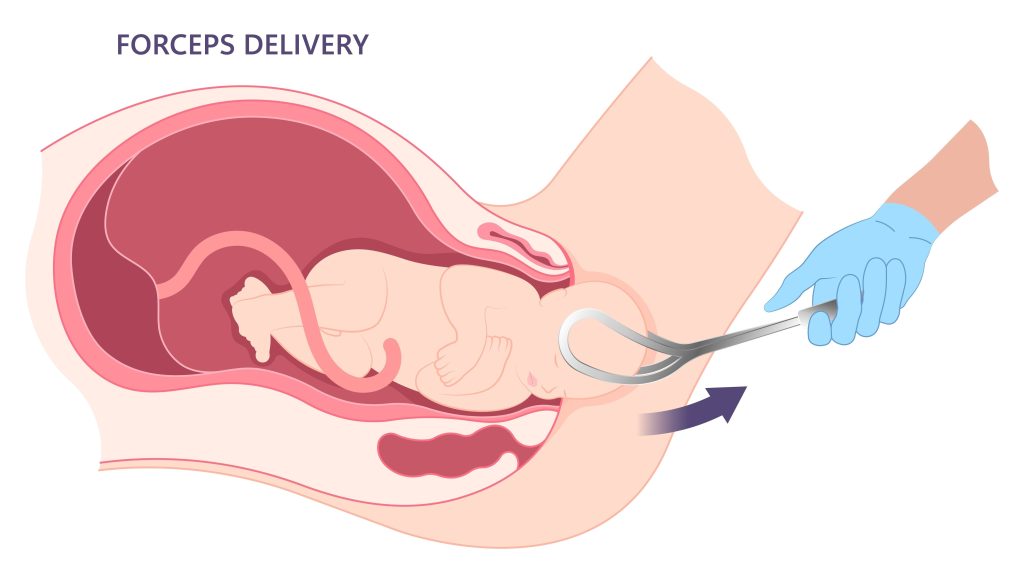
Only a trained obstetrician—not a midwife or general practitioner—should perform a forceps delivery. The process involves:
Medical malpractice often occurs when a doctor ignores “contraindications”—signs that the tool is unsafe for a particular situation. Doctors should generally avoid forceps if:
When used incorrectly—either through excessive force, improper placement, or choosing them when a C-section was the safer path—the injuries can be severe.
To win a medical malpractice claim, a family must prove that the doctor deviated from the standard of care—meaning they did something a “reasonably competent” doctor would not have done.
Birth injury cases are among the most complex in the legal system. They require expert witness medical testimony to analyze fetal monitor strips, hospital protocols, and the physical evidence of the injury. Because these injuries often require a lifetime of specialized care—including physical therapy, surgery, and educational support—settlements in these cases can be substantial, often reaching into the millions of dollars.
If you suspect the improper use of forceps injured your child, it is vital to act quickly, as “statutes of limitations” restrict how long you have to file a claim.
Visit our free consultation page or video. Then contact the Kopec Law Firm at 800-604-0704 to speak directly with Attorney Mark Kopec. He is a top-rated Baltimore medical malpractice lawyer. The Kopec Law Firm is in Baltimore and pursues cases throughout Maryland and Washington, D.C.