Cord Prolapse

Umbilical Cord Prolapse and Medical Malpractice: A Guide for Families

The birth of a child should be a time of celebration. However, when a medical emergency arises in the delivery room, joy can instantly turn into terror. Among the most critical and time-sensitive complications that can result in a medical malpractice birth injury is an umbilical cord prolapse.

When a cord prolapse occurs, the clock begins ticking immediately.  Medical providers have only a matter of minutes to identify the issue and intervene. A failure by medical providers to recognize the risk factors, then diagnose the condition promptly, or perform an emergency delivery can result in catastrophic, permanent brain injury or wrongful death.

The Kopec Law Firm provides this webpage to give a comprehensive overview of umbilical cord prolapse. It includes the underlying anatomy, medical management, and the types of medical malpractice claims that families can bring when medical malpractice leads to a lifetime of disability or loss.

1. Anatomy of the Lifeline: Understanding the Umbilical Cord

To understand why a cord prolapse is dangerous, it is essential to look at the anatomy of pregnancy.

During gestation, the fetus floats inside the uterus, surrounded by amniotic fluid and enclosed within the amniotic sac (membranes). The baby’s sole lifeline is the umbilical cord, which connects the fetus to the placenta.

  • The Blood Vessels: A normal umbilical cord contains three blood vessels: two umbilical arteries and one umbilical vein. The vein delivers oxygenated, nutrient-rich blood from the mother’s placenta to the fetus. The two arteries then carry deoxygenated blood and waste products back to the placenta.
  • Wharton’s Jelly: These vital blood vessels. A gelatinous substance surrounds and protects them. It is Wharton’s jelly. It is all enclosed in a thin layer of membrane. Wharton’s jelly acts as a natural cushion. It prevents the vessels from bending, kinking, or compressing under normal conditions inside the womb.

Under normal labor conditions, the baby moves down the birth canal first (usually head-first). The umbilical cord follows safely behind.
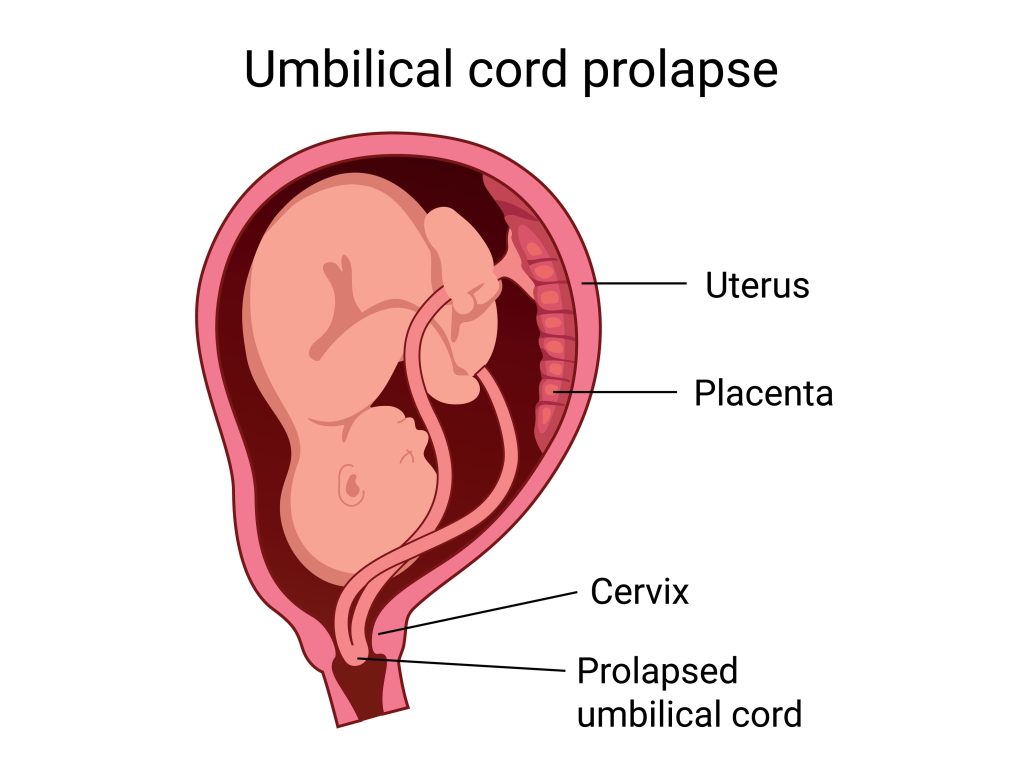
Umbilical Cord Prolapse - Medical Malpractice
Umbilical Cord Prolapse – Medical Malpractice

2. What is Umbilical Cord Prolapse?

An umbilical cord prolapse occurs when the umbilical cord slips through the cervix. It enters the birth canal ahead of or alongside the baby’s presenting part (usually the head or buttocks). This happens during or shortly before labor.

There are two primary types of cord complications to note:

  1. Overt Cord Prolapse: The cord slips completely past the baby’s presenting part. It descends into the vagina. It can sometimes be seen or felt protruding externally. This is a visible, definitive medical emergency.
  2. Occult (Hidden) Cord Prolapse: The cord slips down alongside the baby’s presenting part. However, it remains hidden within the uterus or birth canal, next to the baby’s head or shoulder. It cannot be seen and is difficult to feel during a routine examination.

What Happens When It Occurs?

The primary danger of a prolapsed cord is not the displacement itself, but compression.

When the umbilical cord precedes the baby into the birth canal, the baby’s heavy body parts press directly against the rigid walls of the cervix and vagina during contractions.  The umbilical cord becomes trapped in between.

This squishes the cord flat. It occludes the blood vessels. Then it cuts off the supply of oxygen and blood to the baby. Essentially, a cord prolapse acts like an internal tourniquet on the baby’s oxygen supply. If the compression is complete or prolonged, the baby will suffer from progressive hypoxia (oxygen deprivation) and asphyxia.

3. Risk Factors for Umbilical Cord Prolapse – Medical Malpractice

Certain maternal, fetal, and procedural factors significantly increase the risk. Obstetricians and delivery nurses are trained to be hyper-vigilant when these risk factors are present.

Fetal and Maternal Factors:

  • Abnormal Fetal Presentation: If the baby is in a breech position (feet or buttocks first) or a transverse lie (sideways), there is extra space around the cervix for the cord to slip through.
  • Premature Rupture of Membranes (PROM): If the mother’s water breaks early—especially before the baby’s head has descended firmly into the pelvis—the sudden gush of amniotic fluid can wash the cord down ahead of the baby.
  • Polyhydramnios: This refers to an excessive amount of amniotic fluid. When the sac ruptures, the massive fluid surge carries a high risk of sweeping the cord into the cervix.
  • Multiple Gestations: Delivering twins or triplets increases the risk, particularly for the second or subsequent babies, because the extra room in the uterus allows the cord to shift positions easily.
  • Premature Birth or Low Birth Weight: A small baby does not fully occupy the lower segment of the uterus, leaving gaps where the cord can slip past.

Medical and Procedural Factors:

Medical providers can actually trigger a cord prolapse through certain interventions. If done improperly or without checking the baby’s position first, these procedures can form the basis of a malpractice claim:

  • Artificial Rupture of Membranes (AROM): Amniotomy, or manually “breaking the mother’s water” using a specialized hook, can accidentally wash the cord downward if the baby’s head is still unengaged (high up in the pelvis).
  • Fetal Scalp Electrode Placement / Internal Monitoring: Inserting internal monitors through the cervix can inadvertently displace a loose cord.

4. Signs and Symptoms of a Prolapsed Cord

Because an occult prolapse is invisible, medical teams must rely on indirect diagnostic signs. The primary signs and symptoms include:

  • Severe Fetal Distress / Sudden Bradycardia: The most immediate sign on a continuous fetal heart rate monitor is a sudden, sharp, and prolonged drop in the baby’s heart rate (fetal bradycardia or severe, variable decelerations). A drop below 110 beats per minute that does not recover can be an alarm that the baby is losing oxygen.
  • Visible or Palpable Cord: During a physical pelvic examination, the nurse or doctor may physically feel a soft, pulsating loop of the cord inside the vagina, or the cord may physically protrude past the labia.
  • Changes After the Water Breaks: A sudden drop in the fetal heart rate. It immediately follows the natural or artificial rupture of the amniotic sac and is a classic indicator of a prolapsed cord.

5. Medical Diagnosis: Who and How?

A cord prolapse is diagnosed by members of the labor and delivery team, including:

How It Is Diagnosed

Diagnosis relies heavily on vigilant physical surveillance and electronic monitoring.

Continuous Electronic Fetal Monitoring (EFM): This is the first line of defense. The monitoring strip tracks the baby’s heart rate in relation to uterine contractions. When a prolapse occurs, the strip will show non-reassuring patterns. These can be deep, sharp drops known as variable decelerations or deep bradycardia.

Digital Pelvic Examination: If fetal distress is noted or the mother’s water breaks, the provider should immediately perform a manual pelvic exam. By inserting gloved fingers into the cervix, they can feel if the cord has slipped below the baby’s head.

Ultrasound Imaging: In rare pre-labor cases, an ultrasound might reveal a funic presentation, which means the umbilical cord is resting over the internal cervix before the membranes have broken.

6. Treatment: How Medical Providers Respond to the Emergency

An overt umbilical cord prolapse is an obstetrical emergency. The standard of care requires immediate action to relieve pressure on the cord and then deliver the baby as quickly as possible—ideally within 10 to 15 minutes of the drop in heart rate.

The treatment involves a highly coordinated effort by OB-GYNs, L&D nurses, anesthesiologists, and neonatal resuscitation teams.

Step 1: Relieving Pressure Manually

While preparing for delivery, the immediate priority is to get the baby’s weight off the cord.

  • Manual Elevation: A doctor or nurse will insert a gloved hand into the vagina and physically push the baby’s head or buttocks. They push upward, away from the cervix, to relieve the compression on the cord. The provider must hold this position and keep their hand inside the birth canal, lifting the baby, all the way into the operating room until the surgeon extracts the baby.
  • Maternal Positioning: The mother will be placed into positions that use gravity to shift the baby away from the pelvis. This includes the Knee-Chest position (on hands and knees with face down and buttocks up) or the Trendelenburg position (lying flat on the back with the bed tilted so the head is lower than the pelvis).
  • Tocolytics: In some cases, medications called tocolytics are administered to stop uterine contractions temporarily, as contractions exert downward pressure on the cord.

Step 2: Immediate Emergency Delivery

  • Emergency Cesarean Section (C-section): In the vast majority of cases, an immediate emergency C-section is the only safe way to deliver the baby and avoid severe brain damage. The surgical team must move fast to prep the mother and administer anesthesia.
  • Operative Vaginal Delivery: If the mother is already fully dilated and the baby’s head is very low in the pelvic outlet, the OB-GYN may attempt a rapid delivery using forceps or vacuum vacuum extraction, but only if it can be accomplished faster than a C-section.

7. The Catastrophic Consequences of Delayed Treatment – Cord Prolapse Medical Malpractice

If a prolapsed umbilical cord is not diagnosed and treated within minutes, the lack of oxygen can lead to progressive, permanent destruction of the baby’s vital organs, most notably the brain.

Permanent Brain and Bodily Injuries:

  • HIE: Hypoxic Ischemic Encephalopathy: This is a type of brain dysfunction. It is caused by an inadequate supply of oxygen and blood flow.  HIE can cause destruction of brain tissue.
  • Cerebral Palsy (CP): Oxygen deprivation during birth can cause cerebral palsy, a permanent neurological disorder that can impair body movement, muscle coordination, muscle tone, reflex, and balance. Children with severe CP may require lifelong use of a wheelchair, feeding tubes, and round-the-clock nursing care.
  • Spastic Quadriplegia: The most severe form of cerebral palsy, affecting all four limbs and the trunk, often accompanied by developmental disabilities.
  • Seizure Disorders and Epilepsy: Brain damage from lack of oxygen disrupts normal electrical activity in the brain, causing chronic seizures.
  • Developmental Delays and Cognitive Delays: Children may suffer severe learning disabilities, intellectual delays, vision loss (cortical blindness), or hearing impairments.
  • Organ Failure: Hypoxia can cause damage to the baby’s kidneys, heart, and liver.

Wrongful Death

If the cord is compressed entirely and the medical team takes too long to perform a C-section, the infant may suffer complete asphyxiation, resulting in a stillbirth or death shortly after birth.

8. Navigating Medical Malpractice Claims for Cord Prolapse

Medical schools teach the risks and treatment protocols. Thus, a failure by the medical team to execute these protocols can be a deviation from the standard of care.

To build a successful medical malpractice claim, an attorney must prove that the medical provider breached their duty of care and that this specific failure caused the baby’s permanent injury or death.

Potential Medical Malpractice with Cord Prolapse

Failure to Recognize High-Risk Factors:

Allowing a mother with known polyhydramnios or a breech presentation to move around or undergo routine labor without close, continuous electronic monitoring.

Negligent Performance of an Amniotomy

Artificially rupturing the membranes when the baby’s presenting part is unengaged (high up in the pelvis), which can directly wash the umbilical cord downward.

Failure to Monitor Fetal Heart Rate

Neglecting the electronic fetal monitor or completely missing severe, sudden bradycardia and deep variable decelerations.

Misdiagnosis or Delayed Diagnosis

Failing to perform an immediate physical vaginal examination the moment a sharp drop in the fetal heart rate occurs or immediately after the water breaks.

Delayed Emergency C-Section

Taking an unreasonable amount of time. This can mean exceeding the standard emergency window. This is before prep of the mother and moving her into the operating room once a prolapse is identified.

Failure to Maintain Manual Elevation Removing the examining hand from the vagina prematurely to assist with other tasks, allowing the baby’s weight to re-compress the cord and cut off oxygen before the surgical delivery.

Types of Claims and Recoverable Damages

If a baby suffers a permanent brain injury or dies due to a mismanaged cord prolapse, families can bring a lawsuit seeking substantial compensation. These claims are complex and require the testimony of independent medical expert witnesses (OB-GYNs, labor and delivery nurses, and pediatric neurologists).

Families may seek compensation for several categories of damages often contained in a life care plan:

  • Lifetime Medical Expenses: Covering costs of specialized medical care, surgeries, physical therapy, occupational therapy, and speech therapy.
  • Life Care Planning Costs: Home modifications (wheelchair ramps), specialized vehicles, assistive communication technologies, and 24/7 home health aides.
  • Loss of Future Earning Capacity: Compensation for the income the child would have been able to earn over their lifetime had they not suffered brain damage.
  • Pain and Suffering: Non-economic damages for the physical pain, emotional distress, and loss of quality of life experienced by the child.
  • Wrongful Death Damages: If the baby passes away, parents can then file a wrongful death claim to seek compensation for funeral expenses, medical bills incurred before death, and the profound emotional loss of their child.

What to Do If You Suspect Cord Prolapse Medical Malpractice

The financial and emotional toll of caring for a child with a severe birth injury like cerebral palsy or HIE is overwhelming. If your child suffered an umbilical cord event that caused permanent injury or death, contact us now.

Every state has a statute of limitations (deadlines) for filing medical malpractice and birth injury claims. Contact us for a thorough review of the electronic fetal monitoring strips and delivery room medical records as the first step toward getting the justice and lifetime financial support your child deserves.

Visit our free consultation page or video. Then contact the Kopec Law Firm at 800-604-0704 to speak directly with Attorney Mark Kopec. He is a top-rated Baltimore medical malpractice lawyer. The Kopec Law Firm is in Baltimore and pursues cases throughout Maryland and Washington, D.C.

What Our Clients Say About Us

At the Kopec Law Firm, we are grateful that satisfied clients express their appreciation!

Dear Mark, I just wanted to express my gratitude for your dedication to my case. As you know, it has been a long and upsetting process for me, which would have been a great deal longer had it not been for the hours you put in helping me with this emotional roller coaster. Thank you again.

Shannon T. in Anne Arundel County

Dear Mark, thank you so much for your help and kindness. You provided the guidance and assistance we needed to obtain some understanding in loss of our child. We will never forget the professional and personal service provided. If anyone is in need of legal representation, I will certainly send them your way. God bless.

Kim C. in Cecil County

I wanted to say thank you for spending time with me regarding my questions about legal issues. Mere words cannot really express my gratitude. You seem to truly care about people.

Client in Baltimore City

Dear Mr. Mark, I’m truly grateful to have had you work on my son’s case. You were up front at all times and were on key every step of the way. I will always recommend your firm. Thank you so much for helping my son. P.S. Every time my son sees you on TV, he says “Mom, that’s my lawyer, Mr. Mark.” 🙂 Thank you again. You did an excellent job on the...

K.N. in Baltimore City

Dear Mark, we want to thank you for all the hard work and time your firm put in our case. You took the time to listen to us and research our case. You were honest and up front regarding the case. You responded to questions and concerns quickly. We would highly recommend your firm and services to anyone who is in need of legal representation. We...

Rebecca T. in Prince George’s County

Super Awesome team and staff! Worked with them for a case they handled for my grandchild about 10yrs ago! Would definitely use them again! I recommend them to everyone I know. Could never thank them enough! Very thorough and knowledgeable! Always kept us in the loop throughout the entire process!!!!

Letha C. in Prince George’s County

Mark explained everything in detail and brought clarity to all of my concerns.

Doris in Edgwater

I am very happy and thankful for your help. You responded very quickly. I am very happy to recommend you.

Linda in Chevy Chase

Mark is a knowledgeable and empathetic lawyer who speaks directly and concisely to evaluate your problem. He doesn't use attorney jargon that confuses people, rather he talks clearly. Although he couldn't help me with my situation, the consultation I had was productive because he answered my questions and gave me some clarity.

Shahnaz in Ellicott City
  1. 1 Free Consultation
  2. 2 Talk to a Lawyer
  3. 3 No Fee Unless You Win
Fill out the contact form or call us at 800-604-0704 to schedule your consultation.

Send Us a Message